1. Architecture
The commercial architecture of LUCA is designed to offer a modular, secure platform ready to integrate artificial intelligence capabilities within the data analysis cycle. Its design clearly separates the responsibilities of access, authentication, user interface, business logic, AI orchestration, model deployment, and inference.
At a logical level, the platform is organized into three main domains: access and security, application, and artificial intelligence. This separation facilitates scalability, evolutionary maintenance, and the adaptation of LUCA to different enterprise deployment scenarios.
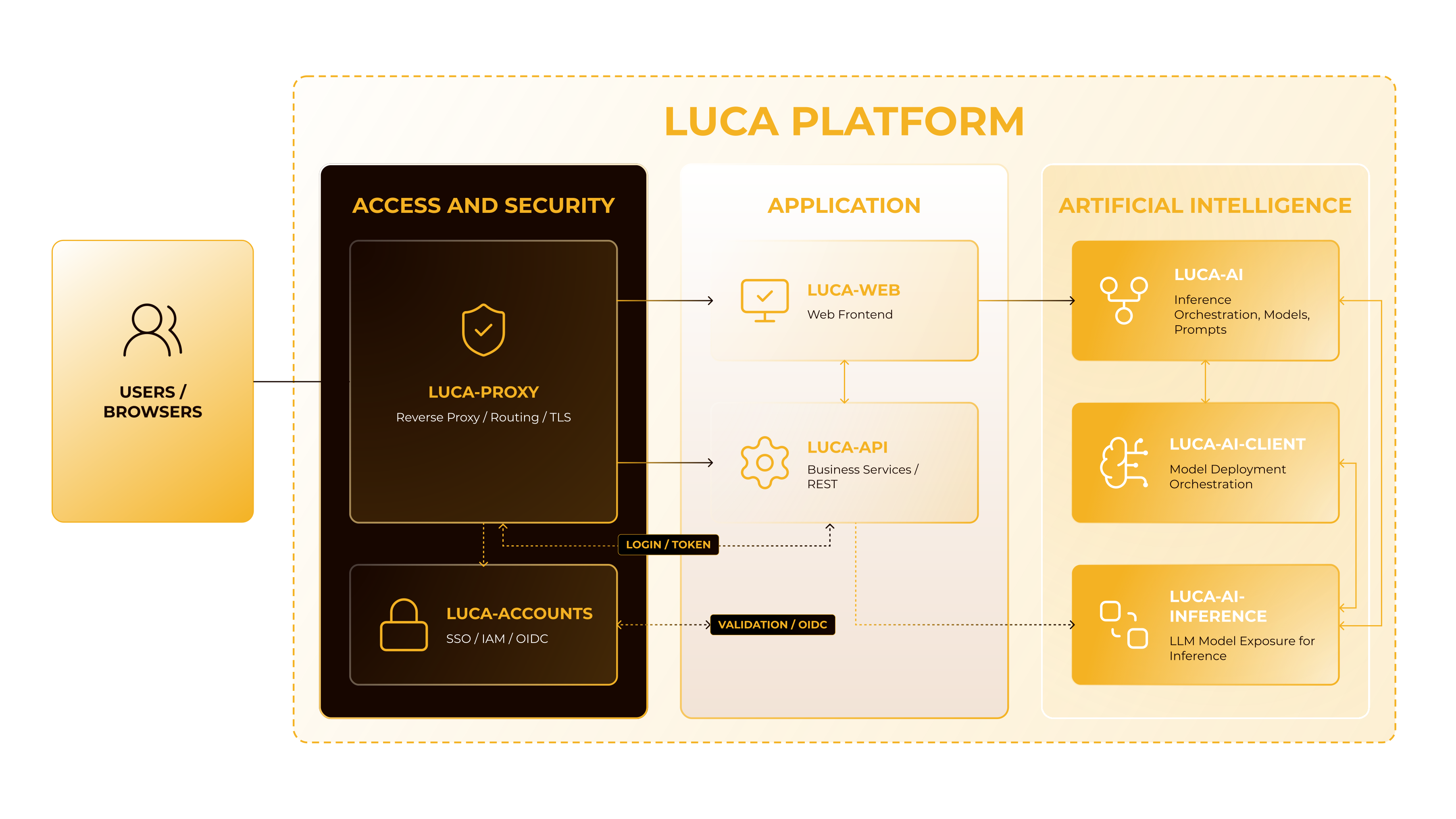 Figure 1.1: LUCA Architecture
Main Components
luca-proxy acts as the entry point of the platform. It centralizes access from users' browsers, manages routing to internal services, and allows the solution to be exposed in a controlled manner through mechanisms such as reverse proxy, routing, and TLS.
luca-accounts provides the identity and access control layer. Its function is to manage authentication, authorization, and integration with standard corporate identity mechanisms such as SSO, IAM, and OIDC.
luca-web represents the web user interface. From this component, users interact with LUCA's functionalities, including visualization, configuration, data exploration, and access to analytical capabilities.
luca-api concentrates the platform's business services. It exposes the main operations through REST interfaces and coordinates communication between the web layer, security services, data sources, and artificial intelligence components.
luca-ai is the intelligent orchestration component. It coordinates processes related to inference, models, and prompts, acting as an intermediary layer between LUCA's business logic and specialized artificial intelligence services.
luca-ai-client manages model deployment orchestration. This component facilitates the preparation, configuration, and operational availability of the models used by inference services.
luca-ai-inference exposes the LLM model for inference. Its responsibility is to provide a specialized execution point for processing artificial intelligence requests and returning results consumable by luca-ai and, subsequently, by the platform's functional logic.
Functional Flow
The user accesses LUCA from the browser through luca-proxy, which routes requests to luca-web or luca-api as appropriate. Authentication is delegated to luca-accounts, which issues and validates the necessary tokens to ensure secure access.
The luca-web interface consumes the services exposed by luca-api. In turn, luca-api concentrates the business logic and coordinates communication with the rest of the platform's internal services.
When an operation requires artificial intelligence capabilities, luca-api forwards the request to luca-ai. This component coordinates inference, model management, and prompt usage, relying on luca-ai-client for model deployment orchestration and on luca-ai-inference for exposing the LLM model used in inference operations.
The result generated by the model is returned in a controlled manner to luca-ai, then to luca-api, and finally to luca-web, where it becomes available to the user within LUCA's functional experience.
Deployment
LUCA is ready to be deployed using containers, which facilitates installation, portability, and operation in different corporate environments. The various components of the architecture — luca-proxy, luca-accounts, luca-web, luca-api, luca-ai, luca-ai-client, and luca-ai-inference — can run as independent services, maintaining a clear separation of responsibilities.
Depending on client needs and the maturity level of their infrastructure, LUCA can be deployed under different models:
Docker standalone allows simple installation on a single server, suitable for demonstration environments, testing, functional validation, or small deployments.
Docker Swarm allows operating LUCA as a set of distributed services, incorporating orchestration capabilities, basic scaling, internal network management, and greater resilience compared to single-node deployments.
Kubernetes offers an advanced deployment model for enterprise environments, with high availability capabilities, horizontal scaling, declarative resource management, integration with observability, network policies, and operational automation.
This container-based approach allows LUCA to be adapted to on-premise, private cloud, or hybrid infrastructure scenarios, maintaining control over the data, security, and computational resources used by the platform.
Architecture Benefits
This architecture makes it possible to decouple critical responsibilities of the platform: access, identity, business logic, user experience, artificial intelligence orchestration, model deployment, and inference.
As a result, LUCA can evolve in a modular way, incorporate new services, integrate different AI models, and maintain a security scheme consistent with enterprise deployments.
The use of independent components also facilitates selective scalability. For example, inference-related services can be scaled specifically according to the required computational load, without necessarily affecting the rest of the platform.
Furthermore, the modular and containerized approach facilitates on-premise, private cloud, or hybrid infrastructure deployments, preserving governance over data and aligning with corporate scenarios where security, traceability, and operational control are fundamental requirements.